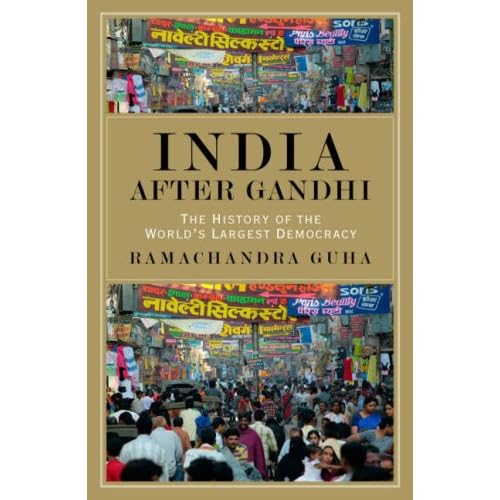
Finished reading Ramachandra Guha's
India after Gandhi a few weeks ago. This is a long overdue post, meanwhile there has been excellent coverage on the blogosphere. Confused's
take on the book is highly recommended - a very comprehensive and fair coverage of the book.
For a most succinct take on the book, here is an excerpt:
And it's bad. Really, really bad.
Basically, this is a work of hagiography (of Nehru, specifically, who deserves better by dint of having been an actual human being, and a quite shrewd one at that) that reflects an intensely partisan outlook: Guha is a partisan of the India's bien-pensant upper-middle left. You'd be far better served by reading anything by Ayesha Jalal or the Marxist intellectual Aijaz Ahmad. Amazingly, given that Guha is a serious scholar and (supposed) left intellectual who has considerable spent time outside India, he offers a Attenborough-esque portrait of a dastardly Jinnah and he demonizes Pakistan. [link]
Prof. Amardeep Singh reviewed the book
chapter by chapter. Indeed, our intellectual circle, basically the
Tehelka types, welcomed this book with open arms even before it had been published.
History tends to throw men into violent feats of partisanship. This was not always so. It used to be really simple in the old days. Country A invaded Country B, killed their leader, looted their gold and abducted their women (perhaps did some conversion too, but that isn't really as important). This was based on a cardinal principle of nationhood - a nation as an entity of a group of people and lead by one man. Under this principle, all actions were due to the leader and only to the leader. History texts were mostly written as actions of nations in the first person. As far as we can tell, no detailed account of debates in the cabinet of Mohammad bin Tughlaq exists. All his disastrous actions are solely attributed to him.
The advent of the modern democratic republics has obviously thrown this system completely out of gear. How do you think history would remember US President George Bush's tenure?
This modern system brought about two changes, one is integral to it and the other perhaps incidental. The first one is the creation of political parties and democratic institutions. This ensures that there are always agents to defend and often modify past actions of leaders. The second one is the increasing global economic prosperity and the high stakes game of modern economics. This one is increasingly leading to violation of the very basis of a democratic republic - which is one set of inviolable rules (constitution) that everyone agrees to and swears to uphold at the time of formation of the nation.
How would Nehru be evaluated today? Clearly a Congress supporter will see Nehru's tenure through rose tinted glasses just like a detractor will constantly attempt to bring attention to irrelevant details of the leader's personal life. Guha goes one step beyond all this - Nehru for him is
Maryada Purushottam, the perfect man who could do no wrong.
All that is considered good in modern India is attributed to Nehru. All that was considered good at the time (such as big nationalized factories) and are coming under scrutiny are described with a sense of nostalgia - as an example, Guha quotes a journalist waxing eloquent about the beautiful town of Bokaro and feeling emotional at the sight of the Bokaro steel plant reflected on a lake. Likewise, the opposition is squarely blamed for anything bad that happened. If Nehru didn't succeed in doing something he should have done, it was again the opposition that thwarted his good intentions. Sometimes it would be detractors within Congress itself, but rarely.
Despite an overwhelming majority, Congress had trouble in the Parliament. This is hard to pin on "opposition" alone. Nehru did have the opportunity to push through many reforms, if he were serious about them. The ultimate blame must lie on Nehru for his lack of vision and mistaken ideas of economics and international relations, not to mention a rather simplistic notion of nationalism which resulted in the often violent events of the linguistic movement. In no place it is clear if Nehru had a strategic road map for a solution. The only deliberate thing he does is talks with Vinobha Bhave! Why invite Chou Eun Lai? This was inviting trouble, already had bad experience with Chinese reaction to Indian protest and desecration of the Mao picture which was a diplomatic fiasco.
The idea that India was a special challenge to bring together a diverse nation may also be an act of Nehru-aggrandizement. Many other nations in history have undergone similar troubles and they had no less complicated situations. But many of them handled their international relations and economy better and came out much better off eventually. India on the other hand was all bark and no bite, literally, with less than 50% of people with food on their table on a regular basis. Praising Nehru as the sole force that brought India together is grossly unfair to the people of India as it is to our other leaders and visionaries, who must be credited with identifying and embracing good ideas.
Guha is also very unkind to some of Nehru's detractors. At one place he describes Vajpayee as a terrier. At another, he talks about
"Congressmen" in jail while Ambedkar served Brits etc. He manages to implicate Vajpayee and Jan Sangh for the Chinese issue while never making it clear what Nehru wanted or if he had any plans at all for settling the disputes. The
Bombay Plan for him was apparently a good thing while it must be seen in light of later events. Clearly this is what led to the crony socialism in today's India - a trend that started much before independence, more on that later.
Guha's book is a difficult read, he strings together hundreds of quotations on each page, meticulously providing the references. In that sense it seems like more of an edited history rather than a written one. It is instructive to note that Guha's source material comes from editorials of newspapers like The Hindu and articles of such eminent personalities as Teesta Sheetalvad.
To be fair, Guha has done a reasonably good job of compilation and as one prominent blogger
commented, one does feel moved by this book. Guha's book will be very useful as a ready reference and we will quote from it extensively in the near future.
Previous:Ramachandra Guha's violent assault on history
Historical Blindness
 "Chamber of death", "harassment", "mental torture", "extreme stress", "worse than religious fundamentalists" [link] - these aren't some of the keywords and phrases you would normally expect from a writer-in-exile when she describes a secular country in which she sought shelter after being driven out from her own.